 Sleeping
 Concerts
 Motorcycle
 Swimming
 Work
 Kids

 On stage
 In the studio
 Rehearsals
 Writing music
 Mixing at home
 Daily commute
 Long journeys
 Listening at home
⏱️ Estimated reading time: 15 min

On this page: Overview
Key Takeaways
For feel, usually yes. Mulberry silk is a smooth, continuous filament with low surface friction, and it takes up more moisture before it feels damp. It is not darker by default, though, and cotton is breathable, temperature-regulating, cheaper and easier to wash. Fit decides darkness, whatever the fabric.
Mulberry silk comes from the domesticated silkworm Bombyx mori, which is reared indoors and fed only on mulberry leaves. It accounts for around 90% of the world’s silk, and its long, even filaments are reeled off the cocoon in one piece rather than spun.
There is no single right number. Most silk eye masks are labelled somewhere between 16 and 25 momme, and 19 to 22 is the usual middle. Momme measures fabric weight, so a higher figure means denser, heavier cloth, not a darker mask.
Start with the fibre label, which should name the material and the percentage, for example “100% mulberry silk”. “Satin”, “silky” and “silk-feel” usually mean polyester. Real silk also tends to warm up quickly when you rub it, and it has a soft shimmer instead of a flat, bright gloss.
It depends on the mask. Many silk masks are hand-wash only, so read the care label before you buy. Our Deep Sleep Mask goes in the machine at 30 °C, inside a laundry bag with the Velcro closed.
A silk sleep mask usually costs more than a cotton one, and its label reads like a list of guarantees: mulberry, 22 momme, 6A grade, pure silk. Most of those words describe the fabric, not how dark the mask keeps your eyes, and a few describe nothing you can check at all. One owner review we read described a silk mask as a pricey buy they almost talked themselves out of, and that hesitation is fair.
The NHS advice for a better night is a bedroom that is “quiet, dark and cool”, and it suggests “wearing an eye mask if light is still a problem” (NHS Every Mind Matters). Any decent sleep mask can do that job. What you are deciding here is whether silk does it better, and what exactly the extra money buys.
At Bollsen, we are a family-owned hearing protection company trusted by 1,000,000+ people, and we also make a mulberry silk mask for the light half of a quiet night. We have read a lot of silk labels, and we would rather tell you where silk earns its price and where cotton is just as good.
Is a silk sleep mask worth it?
A silk sleep mask is worth it if you want the smoothest, lowest-friction fabric against the thin skin around your eyes and you are willing to look after it, because mulberry silk glides rather than drags and holds more moisture before it feels damp, while cotton does a perfectly good job for less money.
What silk will not do is make a mask darker. Darkness comes from fit, meaning how closely the mask sits around the eyes and across the bridge of the nose, so a loose silk mask lets in more light than a well-fitted cotton one.
That gives the verdict two halves. Pay for silk because of how it feels on your face and how it behaves overnight, then judge any mask, silk or not, on fit, strap and washing. Care is where a lot of silk masks lose their value. If the label says hand-wash only in special detergent, the honest answer is that the mask will probably get washed less often than it should.
 Music SoundPRO★ 4.8 · 514 reviews
 Watersafe+★ 4.8 · 684 reviews
 Life+★ 4.7 · 3,700 reviewsLife+★ 4.7 · 3,700 reviewsMusic SoundPRO★ 4.8 · 514 reviewsWatersafe+★ 4.8 · 684 reviewsLife+★ 4.7 · 3,700 reviews
What is mulberry silk, and how is it different from other silks?
Mulberry silk is silk reeled from the cocoons of the domesticated silkworm Bombyx mori, which is reared indoors and fed only on mulberry leaves, and it makes up around 90% of world silk production, according to the International Sericultural Commission.
Because the worms are farmed under controlled conditions, their cocoons give long, even filaments that can be unwound in a single piece. Wild silks behave differently. Tasar comes from silkworms that feed on oak and other forest trees, muga is a golden-yellow silk produced only in Assam, and eri has a filament that breaks, so its cocoons have to be spun like wool rather than reeled.
Every silk filament is built from two proteins. Fibroin is the strong core, and sericin is a gum that coats it and is mostly removed during processing, a step called degumming, to bring out silk’s softness and sheen. That smooth, degummed filament is why mulberry silk feels the way it does against your face.
What does momme mean on a silk eye mask?
Momme (written mm) is a unit of weight for silk fabric, roughly 4.34 grams per square metre for every momme, so a higher number means denser, heavier cloth, and it tells you nothing direct about how dark a mask is or how well you will sleep in it.
The unit comes from the Japanese silk trade, where it was the weight in pounds of a piece of silk 45 inches wide and 100 yards long. On eye-mask labels you will mostly see figures between about 16 and 25 momme, with 19 to 22 the most common. Heavier silk usually feels thicker and wears better, although some owners describe a 22 momme mask as noticeably heavy on the face.
The Which? eye-mask buying criteria make the darkness point plainly: light blocking “depends primarily on the mask’s fit and its prevention of ‘light leakage’ around the eyes and nose, rather than the quality or density of the fabric” (Which?). So read momme as a clue to durability and hand-feel, never as a darkness rating.
Some sellers tell buyers that a listing without a momme figure is a warning sign. It can be, but it is not proof of a fake, and a big momme number printed on a badly shaped mask will not keep a streetlight out.
Why does silk feel different from cotton on your face?
Silk feels smoother than cotton because mulberry silk is a continuous filament only 10–13 micrometres across with a very low surface friction coefficient of around 0.15, while cotton is made of short fibres twisted together, which leaves far more loose fibre ends to rub against your skin (RSC Advances, 2026).
Moisture is the second difference. In the standard commercial values the textile trade uses, silk has a moisture regain of about 11% against about 8.5% for cotton, so silk can take up more water vapour before it starts to feel damp. The same February 2026 review notes the trade-off. Silk passes moisture vapour efficiently but is less effective at wicking liquid, while cotton has effective capillary wicking.
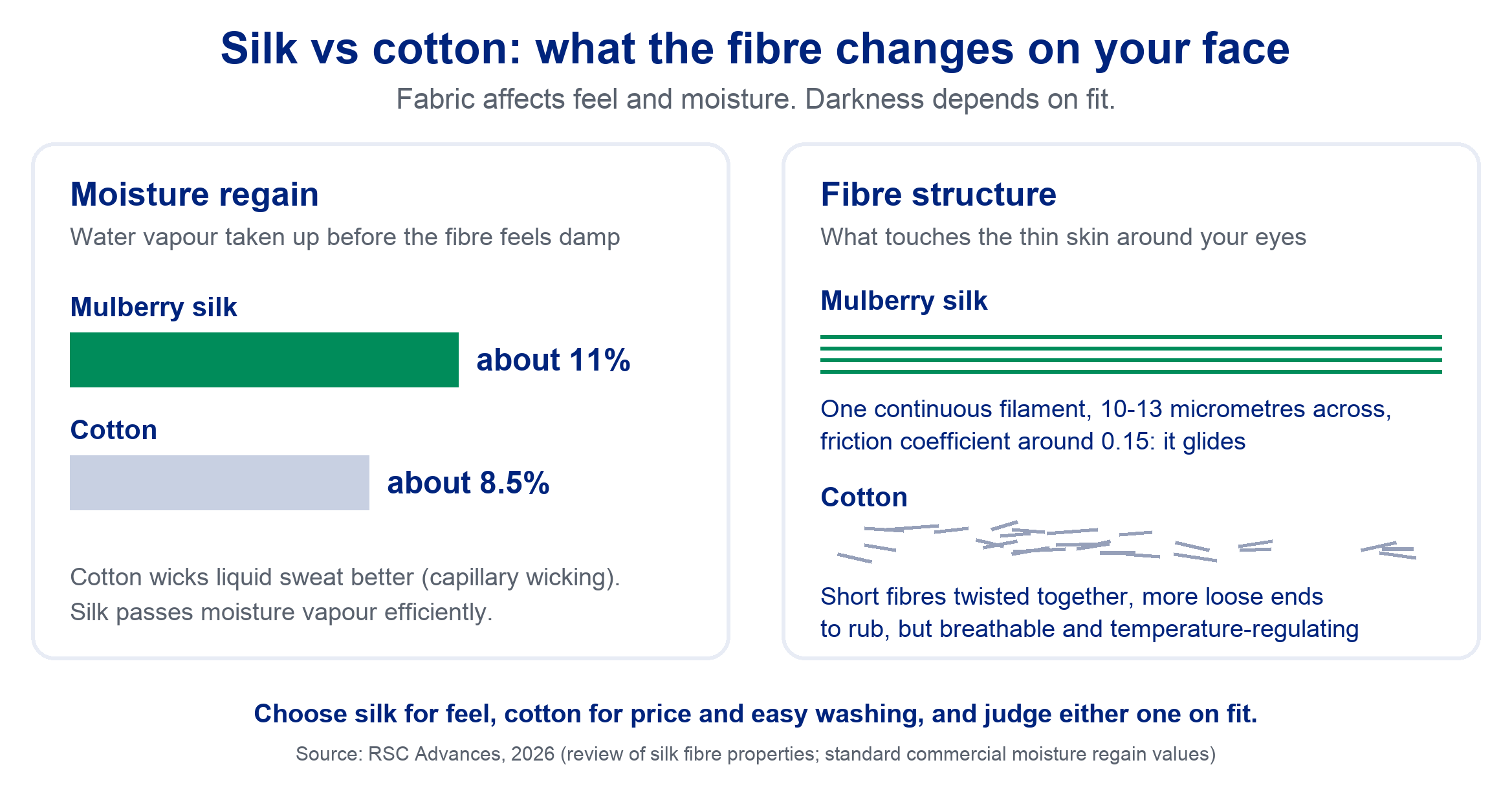
Cotton deserves real credit here. It is breathable and helps regulate temperature, it handles sweat well, and it costs less and goes in the wash without a second thought. If you sleep hot, the fibre is only part of the story, because padding, thickness and how firmly the mask presses on your face matter just as much. Owners are split on heat, with some saying silk never feels sweaty and others finding a cheap silk mask lovely in winter and too warm in July.
Price, washing and breathability are set out side by side in our comparison of silk vs cotton sleep masks, which goes further than the fibre basics covered in this section.
Is satin the same as silk?
No. Satin is a weave, not a fibre, in which threads float over several others to create one glossy face, and it can be woven from silk or from polyester, so a mask sold simply as “satin” is usually polyester unless the label names silk as the fibre.
Polyester satin looks shiny, costs little and blocks light as well as its fit allows, which makes it a reasonable pick for a spare mask. It is a different material, though, without silk’s moisture regain, and many people find it warmer and slicker against the face. How to tell the two apart by touch and label is covered in silk vs satin eye masks.
How can you tell if a sleep mask is real silk?
The quickest check is the fibre label, because a real silk mask names both the fibre and the percentage, such as 100% mulberry silk, while words like silky, satin, silk-feel or silk touch normally describe a look or a finish rather than the material itself.
After the label, use your hands. Real silk tends to warm up quickly when you rub it between finger and thumb and has a soft, slightly dry handle, whereas polyester stays cool and slippery for longer. Tilt it under a lamp as well: silk has a gentle shimmer that shifts with the angle, while polyester often shows a flat, bright gloss.
A burn test settles it if you have a spare loose thread, but only ever a single thread, held with tweezers over a non-flammable dish, and never the mask. Silk smoulders, smells like burnt hair and leaves a soft ash that crumbles. Polyester melts, drips and cools into a hard bead.
These are the label terms you are most likely to meet, with what each one means and what to check before you buy.
| Label term | What it means | What to check |
|---|---|---|
| “100% mulberry silk” | The fabric is entirely silk from Bombyx mori, the domesticated silkworm. | Whether the filling and the strap are listed too, since the figure sometimes covers only the outer fabric. |
| “Mulberry silk” (no percentage) | Some mulberry silk is used, but the share is not stated. | The sewn-in care label or the full fibre content on the listing. |
| “Pure silk” or “100% silk” | Silk fibre, but not necessarily mulberry silk. | Which silk it is. Spun silks such as eri feel different from reeled mulberry silk. |
| “Momme” or “mm” | Fabric weight, about 4.34 g per square metre per momme. | Expect roughly 16–25 momme on a mask, and judge darkness by fit, not by the number. |
| “6A grade” | A grading term sellers use for raw silk filament quality. | There is no independent standard behind the label claim, so give it little weight. |
| “Satin” | A glossy weave, not a fibre. | Whether the fibre is named. Unnamed satin is usually polyester. |
| “Silky”, “silk-feel” or “silk touch” | A description of the finish, not the material. | The fibre label. These masks are usually polyester. |
| “Silk blend” | Silk mixed with another fibre such as cotton or polyester. | The silk percentage, and which fabric actually touches your face. |
What does a good silk sleep mask look like?
A good silk sleep mask pairs an honest fibre label with the things that decide whether you keep wearing it: a fit that stops light leaking around the eyes and nose, a strap that stays put without digging in, comfort through the night, and care instructions you will actually follow, which are the same points Which? judges masks on.
The strap is where many masks give up first. Elastic loses its stretch with washing and can catch and pull at hair, which is why reviewers praise masks that “really don’t move” and grumble about bands that go slack after a few weeks. An adjustable fastening lets you set the tension once and keep it.
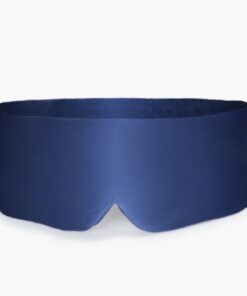
For a silk mask built around fit, strap and washing rather than label numbers, our mulberry silk sleep mask is made from 100% natural mulberry silk with no cotton, fastens with an adjustable Velcro strap that won’t degrade or pull hair, and costs £39.95. It is designed for total darkness, reduces friction on the skin around the eyes and folds away for travel.
It comes in one size and three colours: Navy Blue, Rose Quartz and Triple Black. UK delivery is free on orders over £35, and our 40-day money-back guarantee gives you time to test it against your own bedroom and its early summer light.
How do you wash a silk sleep mask without ruining it?
Start by reading the care label, because most silk sleep masks are hand-wash only and Which? points out that many “can only be washed by hand (if they can be washed at all)”, and a mask that is a chore to clean ends up cleaned far less often than it is worn.
Silk is a protein fibre, so high heat, harsh detergent and rough handling can dull and weaken it over time. Our Deep Sleep Mask is washable at 30 °C in the machine: close the Velcro so it cannot snag, and put the mask in a laundry bag first. Drying, detergent choice and spot-cleaning between washes are covered step by step in how to wash a silk sleep mask.
What else can a silk mask do?
A silk mask can double as a cold compress for the eye area: put our Deep Sleep Mask in the fridge for 20 minutes and it comes out cool enough to wear as a cold compress for a puffy morning, with the fridge as the limit and nothing colder.
Cold narrows the small blood vessels around the eyes, which is the same idea behind chilled eye patches. It is the only skin-related effect we claim for a silk mask, since the silk itself is about friction and feel. Timings, hygiene and when to skip it are covered in using a chilled silk mask as a cooling eye mask.
Silk is also light and thin, so a mask that folds into a coat pocket or wash bag is easy to take on a flight or into a hotel room where the curtains never quite meet.
What are the alternatives to a silk mask?
The main alternatives to silk are cotton masks, which are breathable and cheap, contoured foam masks that hold fabric off the eyelids, weighted masks that add gentle pressure, and gel masks, which most people use for a short cool-down rather than wearing all night.
Each solves a slightly different problem. A weighted mask is mostly about pressure and the feeling of being tucked in, and silk is about the surface against your skin, a difference we compare in detail in weighted vs silk eye masks. Masks with built-in speakers are their own category, and our guide to noise-cancelling sleep masks covers them.
If noise wakes you as well as light, the simplest route is a plain mask plus passive earplugs. Our Life+ earplugs are made from hypoallergenic silicone, reusable, and rated at an SNR of 24 dB.
The Deep Sleep Duo puts that pair of earplugs and our silk mask in one box, so light and sound are covered together.
So is mulberry silk worth it for you?
If the feel of the fabric on your face matters to you, and you want a mask you can wash without a sink full of special detergent, mulberry silk is worth paying for. Read the label for the fibre and the percentage, see momme as a weight rather than a promise, and judge darkness by fit.
If price matters more, a well-fitted cotton mask is breathable and does the job. For the bigger picture on shapes, straps and darkness, our guide on how to choose a sleep mask walks through every option. And if you want to try silk, our Deep Sleep Mask comes with a 40-day money-back guarantee, so the real test is your own bedroom at five in the morning in June.