

 Sleeping
 Concerts
 Motorcycle
 Swimming
 Work
 Kids

 On stage
 In the studio
 Rehearsals
 Writing music
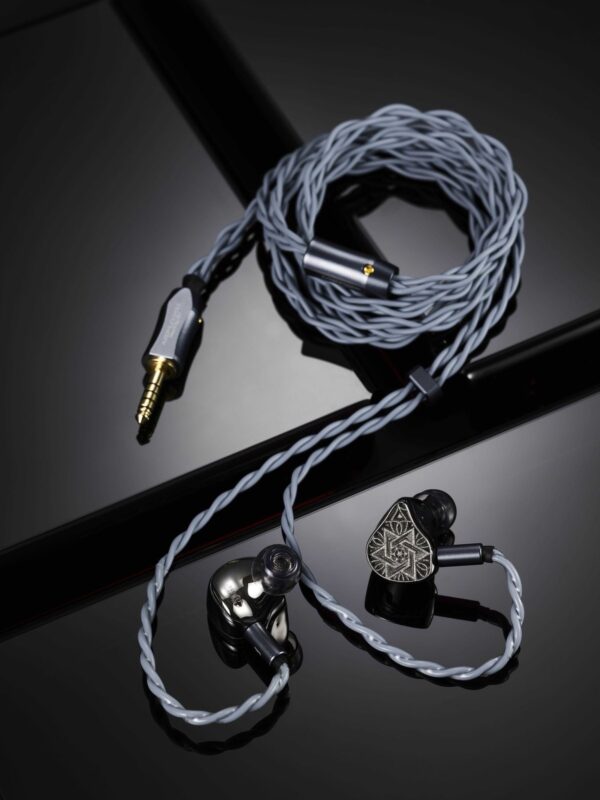 Mixing at home
 Daily commute
 Long journeys
 Listening at home
⏱️ Estimated reading time: 12 min
On this page: Overview
Key Takeaways
If both light and noise wake you, yes. A sleep mask helps create darkness and passive earplugs make the room quieter, so together they cover the two things the NHS lists for a good bedroom: dark and quiet. If only one of them bothers you, start with that one.
It depends on what is in the set. Many cheap bundles pair a basic mask with foam plugs. Our Deep Sleep Duo is the Deep Sleep Mask and Life+ earplugs, the same two products we sell on their own, so the choice comes down to convenience and the current set price on the product page.
A loud alarm stays audible because it is loud. Passive earplugs like Life+ make the room quieter, not silent, and a mask blocks light, not sound. Test your alarm on the first night and turn it up a notch if you need to.
They do a different job. A plain mask with passive earplugs needs no battery, no charging and nothing to pair, and both parts wash separately. If you want audio at night, our guide to noise-cancelling sleep masks covers that category.
Yes, if the strap sits above the ears and the earplug sits flush in the ear. A thick strap over a protruding plug presses into the ear on the pillow side, while a flush, low-profile earplug and a thin adjustable Velcro strap leave nothing for the pillow to push on.
Should you wear a sleep mask and earplugs together? If a street lamp and a snoring partner both wake you, usually yes. Light and noise disturb sleep through different routes, and no single plain device covers both. The NHS advice for a better night is a bedroom that is “quiet, dark and cool”, with earplugs if noise is a problem and an eye mask if light still gets in (NHS Every Mind Matters).
At Bollsen, we make hearing protection trusted by 1,000,000+ people, and a mulberry silk sleep mask for the light half of the same problem. On sleep forums, people keep landing on “a silk mask with silicone earplugs”. Our own UK orders say the same: a mask and Life+ are one of our most common pairings.
Why do light and noise wake you up in different ways?
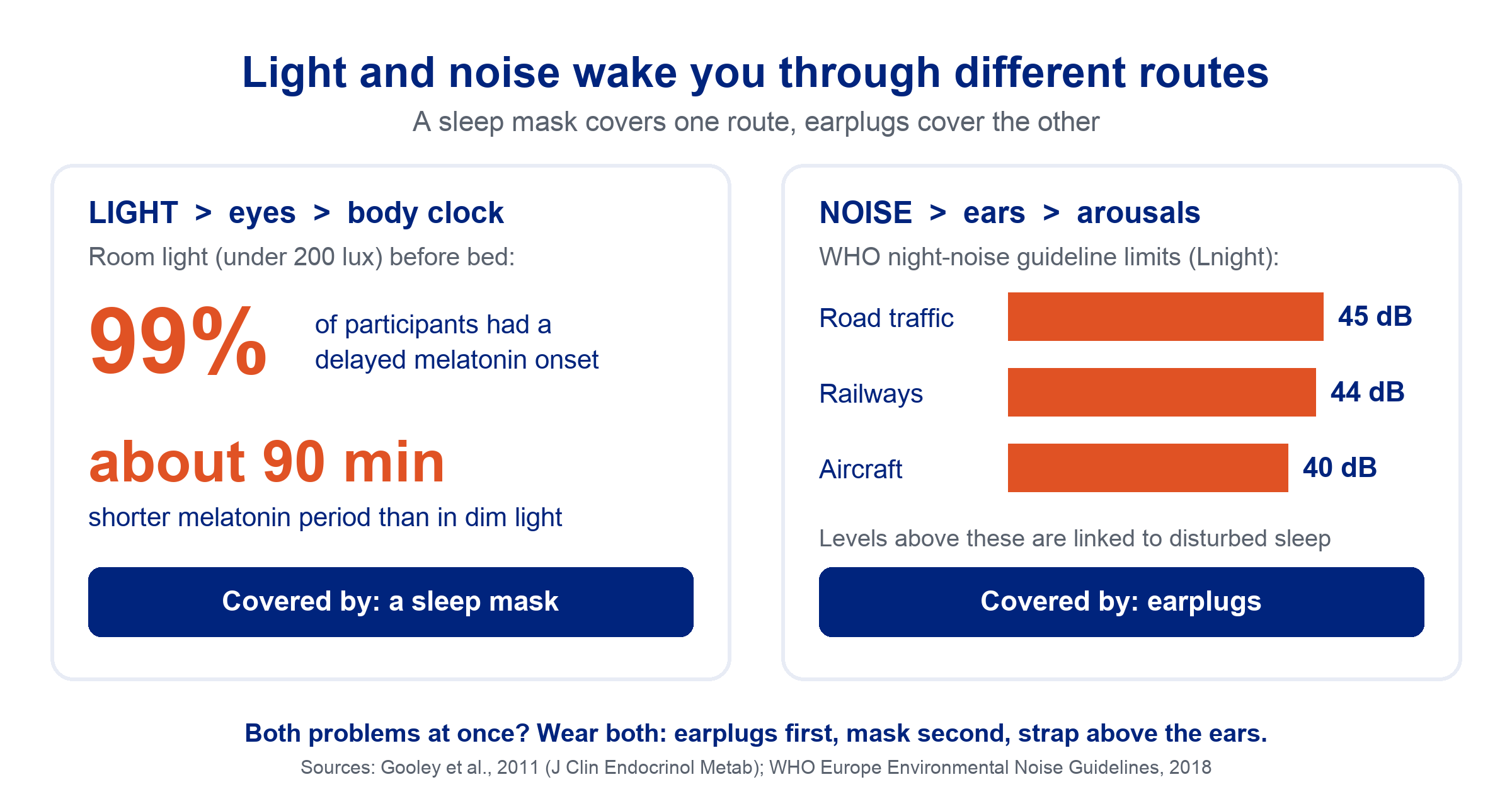
Light at night works on the body clock through the eyes and holds back melatonin. Noise works through the ears and causes brief arousals and awakenings. A mask and an earplug each cover one route and leave the other open.
The light side is well measured. In a controlled laboratory study, ordinary room light (under 200 lux) before bedtime delayed melatonin onset in 99% of participants and shortened the melatonin period by about 90 minutes compared with dim light (Gooley et al., 2011). Darkness supports natural melatonin release. That is the mask’s job when curtains, a partner’s reading lamp or a 4:30am summer sunrise let light in.
Noise is a separate problem with its own limits. The World Health Organization’s night-noise guidelines recommend keeping road traffic below 45 dB Lnight, railways below 44 dB and aircraft below 40 dB, because levels above these are linked to disturbed sleep (WHO Europe, 2018). A mask does nothing about a lorry on the bypass, and an earplug does nothing about the streetlight through a gap in the blind.
 Music SoundPRO★ 4.8 · 514 reviews
 Watersafe+★ 4.8 · 684 reviews
 Life+★ 4.7 · 3,700 reviewsLife+★ 4.7 · 3,700 reviewsMusic SoundPRO★ 4.8 · 514 reviewsWatersafe+★ 4.8 · 684 reviewsLife+★ 4.7 · 3,700 reviews
Who needs both a sleep mask and earplugs?
A sleep mask and earplugs together suit anyone whose bedroom has a light problem and a noise problem at the same time. In practice that means people sharing a bed, people sleeping in daylight and people sleeping away from home.
The classic case: a partner who snores and reads with the lamp on, or a city flat with a streetlight outside and traffic below. For the snoring half on its own, our guide to sleeping next to a snoring partner goes through the options before a mask joins the routine.
Shift workers sleep while the house is bright and busy, with deliveries, school runs and neighbours mowing at noon. A sleep mask for shift workers handles the daylight, and our guide to earplugs for shift workers covers the daytime noise side of a sleep schedule that runs against the clock.
Travellers get both problems at once: cabin lights and engine hum on a night flight, a hotel corridor and a blackout curtain that does not quite meet. A travel sleep mask folds into a bag next to a small earplug case, and we cover the sound half in our guide to aeroplane earplugs for flights and pressure changes.
What should you look for in the mask and the earplugs?
The mask needs to create total darkness without pressing on the eyes, and the earplugs need a measured noise rating plus a fit that stays flat against the pillow. Each half fails in its own way when it is uncomfortable.
For the mask, look at the light seal around the nose, the fabric against your skin and the strap. Our Deep Sleep Mask is natural mulberry silk with no cotton, which reduces friction on the skin around the eyes, and it has an adjustable Velcro strap that will not degrade or pull hair. It is washable at 30 °C, folds for travel, comes in Navy Blue, Rose Quartz and Triple Black, and is one size. Our guide on how to choose a sleep mask goes through every criterion.
For the earplugs, the number to check is the SNR rating, and the shape matters as much as the material. Life+ is a passive silicone earplug rated SNR 24 dB (H 24 / M 21 / L 19), German-tested and independently certified, with an ultra-low-profile flush fit, hypoallergenic silicone, reusable for up to 100 uses and an aluminium travel case. Our pages on earplugs for sleeping and the best earplugs for sleeping explain foam versus silicone, sizing and SNR in full.
Mask only, earplugs only or both: which setup covers what?
A plain mask covers light only, earplugs cover noise only, and the mask plus earplugs pair covers both with no battery, while a headphone mask adds electronics and charging to the bedside routine. The table sets the four side by side.
| Setup | Light | Noise | Power needed | Side-sleeper comfort | Washing |
|---|---|---|---|---|---|
| Mask only | Total darkness with a good seal | No change | None | Thin strap, nothing in the ear | Deep Sleep Mask: machine wash at 30 °C |
| Earplugs only | No change | Quieter, not silent (Life+ SNR 24 dB) | None | Flush, low-profile plug stays clear of the pillow | Water and mild soap, reusable up to 100 uses |
| Mask + earplugs | Total darkness | Quieter, not silent | None | Good when the strap sits above the ears | Each part washed on its own |
| Headphone mask | Covers the eyes | Plays audio, depends on the model | Battery, needs charging | Speaker housings sit over the ears | Electronics removed first |
Masks with built-in speakers are a separate category with their own trade-offs. If you would rather fall asleep to audio than to quiet, our guides to noise-cancelling sleep masks and sleep masks with headphones cover the electronic options, from batteries to charging.
Is a mask-and-earplug set better than buying separately?
A mask-and-earplug set is only better than separates if you would choose both parts on their own. Many low-cost sets pair a basic mask with disposable foam plugs, and the earplug is usually where the corner gets cut.
That is why we built the Deep Sleep Duo, a mask and earplugs set from the two products we already sell separately, so nothing in the box is a cheaper stand-in. You can see the current set price on the Deep Sleep Duo page. What you gain is convenience. One order, one bedside routine.
Buying separately makes sense if you already own earplugs you like or only need one half. The Deep Sleep Mask costs £39.95 and already clears our free UK delivery threshold of £35. For the sound half, Life+ earplugs (passive SNR 24 dB, £29.95) are the same plugs that go in the set, and everything comes with our 40-day money-back guarantee.
How do you wear a sleep mask and earplugs comfortably?
Put the earplugs in first, then the mask, and set the strap so it runs above the ears rather than across them. A strap pressing over an earplug is the most common reason people give up on the pair.
Side sleepers on forums call it the “sandwich effect”: a thick strap pushes a protruding plug into the ear on the pillow side until the ache wakes them. The answer is shape, not padding. A flush, ultra-low-profile earplug leaves nothing for the strap or pillow to press, and our guide to earplugs for side sleepers covers fit and sizing for sleeping on one ear.
Comfort decides whether the pair gets used at all. In a 2017 hospital trial of earplugs and an eye mask worn together by 64 intensive care patients, around 30% of the intervention group did not keep their earplugs in all night (Demoule et al., 2017). A bedroom is not an intensive care unit, but the lesson carries over: a plug that pinches comes out by 3am.
For the alarm, remember that Life+ makes the room quieter, not silent, and a loud alarm stays audible because it is loud. Test it on the first night with both on. If you plan to wear earplugs every night, our article on whether sleeping with earplugs is safe covers nightly use, wax and cleaning habits.
What about a sleep mask with ear covers or ear muffs?
A sleep mask with ear covers or ear muffs is still a passive mask, with padded fabric flaps that rest over the ears, and it softens sound rather than sealing the ear canal the way an earplug does.
The appeal is obvious if you dislike anything in your ear: one piece, nothing to insert, nothing to lose in the sheets. The trade-off shows up at night. The covers add bulk on the pillow side for side sleepers, they hold warmth around the head on a summer night, and because fabric over the ear does not seal, they muffle a snoring partner less than a well-fitted earplug.
If you sleep on your side or run warm, a thin silk mask with a separate flush earplug keeps the pillow side flat and the ears cooler, and each part can be washed on its own.
What does research say about masks and earplugs worn together?
The research on masks and earplugs together comes mostly from hospitals, where light and noise run all night. It looks at the pair as one setup, not at either item alone.
In one controlled study, 14 healthy volunteers slept under recorded intensive care noise and light. When they wore earplugs and eye masks together, they had fewer arousals and higher melatonin levels than without them (Hu et al., 2010). That is a finding about the pair in a noisy, bright room, not about any one mask, and our evidence guide on do sleep masks work looks at what studies show for masks on their own.
So which setup should you choose?
If only light wakes you, a silk mask on its own is enough. If only noise wakes you, start with earplugs. Both? Wear them together: earplugs first, mask second, strap above the ears, and a flush plug if you sleep on your side.
The Deep Sleep Duo puts our mulberry silk mask and Life+ earplugs in one box, and both parts are also sold separately if you only need one. Try the pair for a few nights. If it does not suit your bedroom, our 40-day money-back guarantee covers you.
