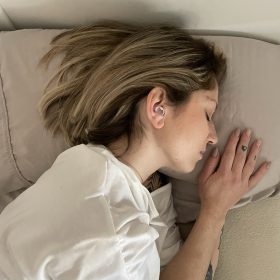
 Sleeping
 Concerts
 Motorcycle
 Swimming
 Work
 Kids

 On stage
 In the studio
 Rehearsals
 Writing music
 Mixing at home
 Daily commute
 Long journeys
 Listening at home
⏱️ Estimated reading time: 13 min
On this page: Overview
Key Takeaways
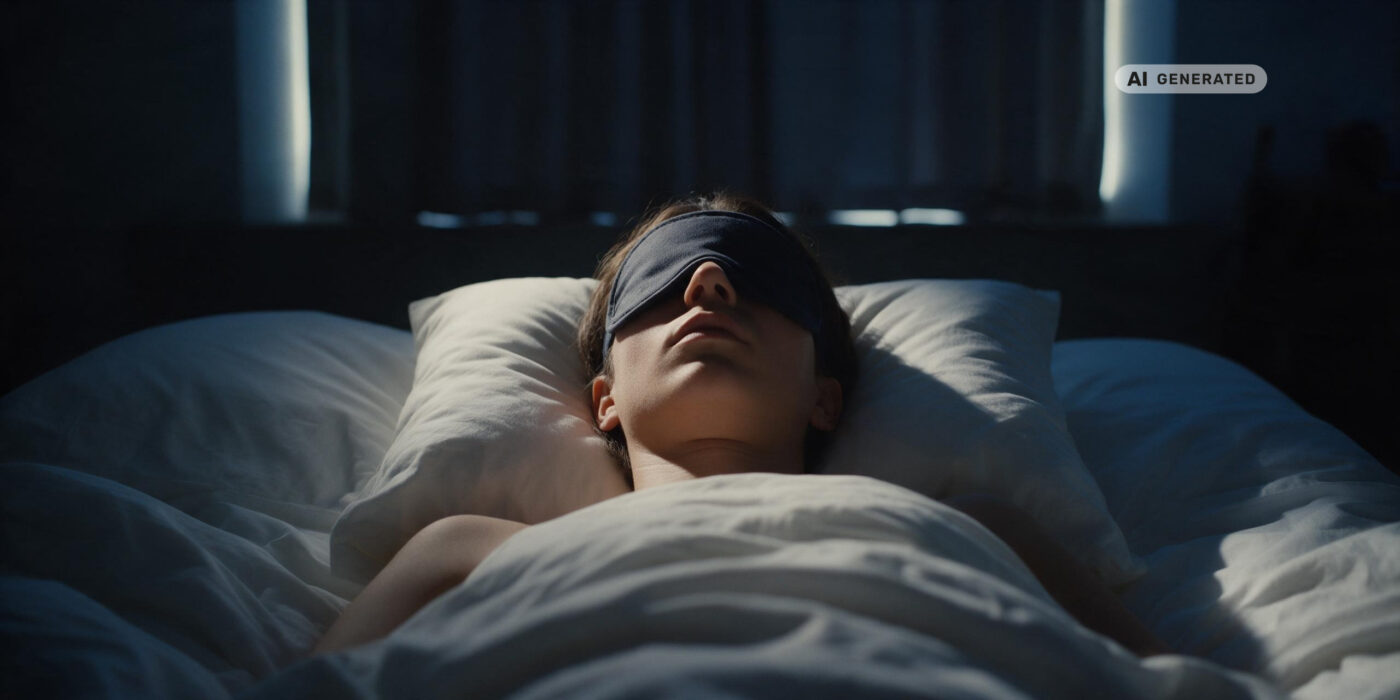
You put the mask on, switch off the lamp, and a thin glow still shows at the bottom edge, right beside your nose. A blackout sleep mask is supposed to stop exactly that. Yet buyers describe the same thing again and again in reviews: “a sliver of light creeps in at the bridge”, or the mask is fine on their back and leaks the moment they roll onto their side.
The fabric is rarely to blame. At Bollsen we make earplugs and sleep products trusted by 1,000,000+ people, and when a sleep mask lets light in, it nearly always gets in at the edges. Here is where those leaks sit, what closes them, and a two-minute torch test for total darkness you can run tonight.
What makes a sleep mask truly blackout?
A blackout sleep mask is one that seals against your face well enough that no visible light reaches your eyes, and that depends far more on the light seal at the nose bridge, cheekbones and temples than on how dark or thick the fabric looks in the packet.
Most masks sold as blackout already use opaque fabric. But a mask that lies flat on a table can still gap on a face, because faces are not flat. Noses stick out, cheekbones vary, and the temples curve away.
So the useful question is not whether the label says blackout. It is whether the mask stays sealed on your face, in your sleeping position, for the whole night.
 Music SoundPRO★ 4.8 · 514 reviews
 Watersafe+★ 4.8 · 684 reviews
 Life+★ 4.7 · 3,700 reviewsLife+★ 4.7 · 3,700 reviewsMusic SoundPRO★ 4.8 · 514 reviewsWatersafe+★ 4.8 · 684 reviewsLife+★ 4.7 · 3,700 reviews
Where does light leak into a sleep mask?
Light leaks into a sleep mask at three places: the nose bridge, where the lower edge lifts off the face on both sides of the nose, the cheekbones along the bottom edge, and the temples, where the sides of the mask meet the strap line.
The nose bridge is the one people mention most, so check it first. Light through the fabric itself is much rarer.
| Leak point | Why light gets in | How to close it |
|---|---|---|
| Nose bridge | The nose pushes the fabric forward and leaves a small triangular channel on each side | Press the lower edge into the sides of the nose after putting the mask on, and again after you turn over |
| Cheekbones | Prominent cheekbones hold the lower edge off the skin below them; a pillow on one side tilts the mask | Seat the mask slightly lower so the edge rests on the cheek, then check it lying on your side |
| Temples | A loose or low strap lets the sides lift, and the mask slowly rides up overnight | Move the strap higher on the back of the head and set a firm tension that holds |
| Through the fabric | A single thin layer can glow when bright light hits it | Choose dense or layered opaque fabric |
Why does the nose bridge let the most light in?
The nose bridge lets in the most light because the nose projects forward from the face, so the mask fabric stretches across it like a small tent and leaves two triangular openings, one either side of the nose, exactly where the lower edge ought to rest on your cheeks.
Side sleeping makes it worse. The pillow pushes into one edge, tilts the mask and lifts the opposite side off the face, which is why so many masks work on the back and leak as soon as you turn over.
Time plays a part too. Independent long-form reviews describe a single elastic band creeping upward over roughly four to five hours of sleep, pulling the mask off the nose as it goes. And faces differ. “It fit my wife but was too small for my husband” is a common review line.
What closes the gaps around a sleep mask?
Three levers close the gaps around a sleep mask: fabric opacity, so no light passes through the cloth, fit to your face, so the edges rest on the skin, and strap tension and height, so the mask stays where you put it all night without pressing on your eyes.
Fabric opacity and layers
A single thin layer can glow when a street light or sunrise hits it, and dense or layered fabric stops that. Once the cloth is opaque, extra thickness does little, because the remaining light comes in at the edges.
The fibre matters less than the build. Cotton masks are breathable and good at regulating temperature, and a well-made silk mask can be just as dark. We make no claim that one colour of our mask blocks more light than another.
Fit to your face
Contoured masks with eye cups hold the fabric off the eyes and can follow the brow, while soft flat masks drape closer to the cheeks and the sides of the nose. Neither shape wins on light by default; the seal depends on your particular face. We look at who suits which shape in contoured vs flat sleep masks.
Strap tension and height
The strap should be firm enough that the mask does not move when you turn your head, but not so tight that it leaves pressure marks. A strap sitting above the ears, on the back of the head, holds position better than one running round at ear level, and an adjustable strap keeps its tension where elastic slowly gives. There is more on positioning in our step-by-step on how to wear a sleep mask.
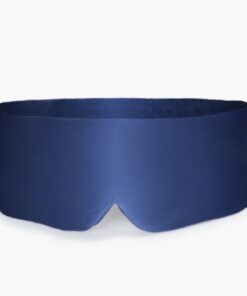
We designed our mulberry silk sleep mask designed for total darkness around these points. The Deep Sleep Mask is made from natural mulberry silk with no cotton, and its adjustable Velcro strap won’t degrade or pull your hair, so the tension you choose at bedtime is the tension you still have at dawn. It is washable at 30 °C, folds flat for travel and comes in one size and three colours (Navy Blue, Rose Quartz and Triple Black) for £39.95, with free UK delivery over £35 and our 40-day money-back guarantee.
How do you test whether your mask is dark enough?
The simplest test for a blackout sleep mask takes about two minutes: wear it in a dark room, shine a phone torch at each leak point and then lie in your usual sleeping position, because any glow you see during the test is light that will reach your eyes at dawn.
- Make the room as dark as you can and switch on your phone torch.
- Put the mask on exactly as you would at bedtime, with the strap at its usual height, and press the lower edge into the sides of your nose.
- Keep your eyes open under the mask. Hold the torch about an arm’s length away and point it at the nose bridge from below, then at each cheekbone, then at each temple.
- Look down towards your cheeks while you do it, because the lower edge is where most gaps hide.
- Lie down in your usual position, on your side if that is how you sleep, with the torch on the bedside table pointing at you. Stay there for two minutes.
- If you saw light at any point, press the bridge back in, move the strap higher or tighten it slightly, and run the test again.
If you can see the glow of an alarm clock through the gap by your nose, the mask is not sealed. If the glow survives two rounds of adjusting, the shape probably does not suit your face.
Why isn’t a blackout percentage a real measurement?
There is no standard light-blocking rating for sleep masks, so a blackout percentage printed on a box is not a figure you can compare from one brand to the next, and the seal it claims to describe depends on your face and your sleeping position as much as on the mask.
Independent testers use their own methods. Which? assesses eye masks with a panel of testers and a digital light meter that measures how much light gets through, alongside comfort, fit and whether the strap adjusts. Careful, but its own method, not an industry rating.
When we say total darkness, we mean something narrower and more useful. No visible light reaches your eyes, in your position, in your room. You can check that yourself with the torch test above, which no percentage lets you do.
Why does darkness at the eye matter even with your eyes closed?
Darkness at the eye matters because closed eyelids are not a light-proof barrier: a 2023 study in Color Research & Application estimated that eyelids let through roughly half of red light on average but only about 4.5% of blue light, with large differences between people.
Light also affects the body’s timing signals. In a study of 116 adults aged 18 to 30, room light in the evening delayed melatonin onset compared with dim light and shortened melatonin duration by about 90 minutes. Harvard Health notes that even about 8 lux of light, roughly twice a night light, has a measurable effect on circadian rhythm and melatonin secretion, which is why a standby LED or a street lamp is worth taking seriously.
Light during sleep itself has been studied as well. Northwestern researchers found that one night of sleeping with moderate room light (about 100 lux) raised night-time heart rate and was followed by higher insulin resistance the next morning, compared with a dim room. A dark sleeping environment supports the body’s natural melatonin release, and we cover the wider picture of how light affects sleep in a separate guide.
What if the room is the problem, not the mask?
If light reaches you from several directions, such as a street light round the curtains, a standby LED across the room and an early sunrise in June, darkening the room and wearing a mask work best together, because the mask has far less to hold back once the room is already dim.
Thicker curtains, tape over a charger light and a well-sealed mask all add up. We weigh the two approaches in sleep mask vs blackout curtains. And if the early light arrives with early noise, our Deep Sleep Duo pairs the mask with Life+ earplugs (SNR 24 dB) for darkness and quiet in one set.
A blackout sleep mask is only as dark as its seal. Check the nose bridge first, set the strap high and firm, and run the torch test in the position you actually sleep in. If your mask still glows after that, change the shape or fit, not the fabric.
For the rest of the decision, from fabric to strap to washing, see how to choose a sleep mask. Then switch the lamp off and enjoy the dark.