 Sleeping
 Concerts
 Motorcycle
 Swimming
 Work
 Kids



 On stage
 In the studio
 Rehearsals
 Writing music
 Mixing at home
 Daily commute
 Long journeys
 Listening at home
⏱️ Estimated reading time: 11 min
On this page: Overview
Key Takeaways
Take the ear tips off, hold each IEM nozzle-down and lift wax out with a soft dry brush or wax loop. Wash silicone tips in mild soapy water, wipe the shell with a dry or barely damp cloth, check the 2-pin sockets for moisture and let everything air-dry before it goes back in the case.
Yes, silicone tips can be washed. Pull them off the nozzle, rinse them in warm water with a drop of mild soap, rinse again and let them dry completely before you refit them. Foam tips are better replaced once they stop recovering their shape.
Give them a quick wipe and a nozzle check after every use, as Ultimate Ears Pro recommends. Washing the tips and checking the sockets once a week, or sooner if the sound turns dull, is our practical suggestion rather than a medical rule.
Sharing ear tips is best avoided. A small 2008 study grew bacteria from most earphone swabs and concluded it is better not to share earphones, or to clean them first. If someone has to try yours, give them fresh tips and clean the IEMs afterwards.
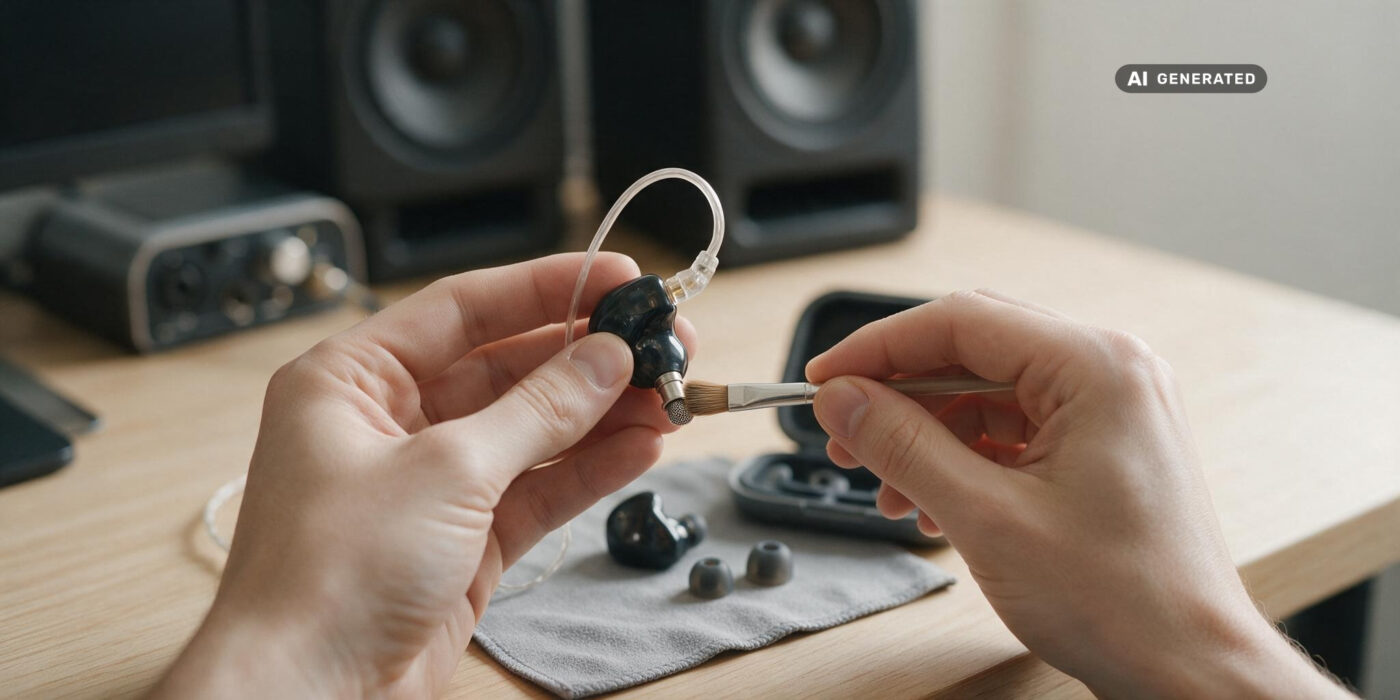
Hold the IEM with the nozzle pointing down so loosened wax falls away from the opening. Brush across the mesh with a soft dry brush, then use the loop end of a cleaning tool lightly around the rim. Never push anything through the mesh and never add liquid.
Knowing how to clean IEMs comes down to one rule: keep liquids away from the nozzle and the sockets. Earwax, sweat and a damp case are what clog a nozzle and corrode a socket.
Ever felt a pick was pushing wax further into the nozzle instead of out? The six steps below are built around that worry. If you are new to the category, start with what are in-ear monitors.
At Bollsen, we are a family-owned hearing company from Ljubljana and the official UK & EU partner of Unique Melody. This guide is about IEMs only; for foam and silicone plugs, see our guide on how to clean reusable earplugs, which follows a different routine.
What do you need to clean IEMs?
To clean IEMs you need a soft dry brush or an IEM cleaning tool with a wax loop, a lint-free cloth, warm water with a drop of mild soap for silicone tips only, and a dry cotton swab for the sockets. You do not need alcohol, sprays or a vacuum.
Check your box first. Per the product pages, the MEXT, MEST MKII, MEST MKIII CF Blue, Maven III Moonshard and MEST Fortune come with a cleaning tool. The 3DT, From The Start, Stardust, MEST Jet Black and Mason FS come with a cleaning cloth, The Multiverse Mentor with a cleaning pad.
The 2HT ships with a case and tips but no tool or cloth, so use a soft dry brush or a separate cleaning tool. Whatever you use is for the IEM only, never your ear canal.
How do you clean IEMs, step by step?
You clean IEMs in six steps: take off the tips, clear the nozzle with dry tools while it points down, wash the silicone tips, wipe the shell, check the 2-pin sockets for moisture, then let everything air out before it goes into the case.
1. Take off the ear tips
Remove the IEMs by the shell, not the cable, then peel each tip off the nozzle by its base. Now you can see the nozzle mesh, and the tips can be washed well away from the drivers.
2. Clear the nozzle with dry tools, pointing down
Turn the IEM so the nozzle faces the floor. Ultimate Ears Pro advises holding it “with the canal facing downward so that wax particles fall out and away” rather than into the device. Brush across the mesh first, then work the wax loop gently around the rim.
Go lightly. Shure’s SE215 guide warns “do not force any object through the earphone nozzle”, because the filter behind it can be damaged. On a model like the 2HT, with its metal nozzle and mesh, that mesh is the part to handle gently. If your model came with spare filters (the Mason FS does), change them only as the maker’s instructions say.
3. Wash the silicone tips and dry them fully
Swirl silicone tips in warm soapy water, rinse them and leave them on a clean cloth to air-dry. Shure says sleeves “must be completely dry before reusing”. A damp tip carries moisture straight back onto the nozzle.
Foam tips take much longer to dry and wear out faster. Replace them once they stay squashed or start to crumble, and if a tip no longer seals, our guide to choosing IEM ear tips covers sizes and materials for the next set.
4. Wipe the shell with a dry or barely damp cloth
Wipe the shell and faceplate with a lint-free cloth, dry or very lightly dampened with water and wrung out. Keep the cloth away from the nozzle and the vents, and use no solvents or cleaning sprays.
5. Check the 2-pin sockets and the cable plug
Every Unique Melody IEM we sell uses a 2-pin connector, and JH Audio notes that “the socket area is a prime spot for corrosion to occur due to sweat”. Once a week, look into the sockets and at the cable pins for moisture or green or dark residue, and dry them with a dry cotton swab.
There is no need to unplug the cable after every session; JH Audio suggests removing it periodically to clean the sockets. How each connector type seats and releases is covered in IEM cables and connectors.
6. Let them air out, then store them in the case
JH Audio’s advice after sweaty sessions is to “never put the IEMs directly back into the case. Let them air out and dry for a bit.” Ultimate Ears Pro adds that sweat and earwax are slightly acidic, so trapping them in a closed case between uses is worth avoiding. JH Audio also suggests a small silica gel packet in the case to help draw moisture away from the drivers.
Does the shell material change how you clean it?
The shell material does not change the routine, because none of the Unique Melody product pages gives material-specific cleaning advice and we have not found a Unique Melody cleaning guide. So we use the same rule on every shell: a dry or barely damp cloth, no solvents, nothing wet near the nozzle or sockets.
The materials still differ. The Stardust has a 3D-printed titanium shell and comes with a cleaning cloth. The MEST Jet Black pairs a zirconia ceramic shell with an aluminium faceplate, also with a cloth in the box. The 2HT has a hand-finished shell, a metal nozzle with a mesh and no cleaning tool in the box.
Manufacturers disagree on alcohol. JH Audio’s care page wipes shells with alcohol on a cloth; Shure’s guide says “Do not use alcohol-based disinfectants”. With nothing from Unique Melody either way, we stick to the cautious dry wipe.
Custom-fit shells, offered on the MEXT, MEST MKII, MEST Jet Black, MEST Fortune, The Multiverse Mentor and Mason FS, follow the same routine. Custom IEMs from another maker should follow that maker’s own care guide.
How often should you clean IEMs?
Clean IEMs lightly after every use: a wipe of the shell and a look at the nozzle, which Ultimate Ears Pro says “goes a long way to avoid potentially damaging build up”. A fuller clean of tips and sockets once a week is our practical suggestion, not a medical rule.
Sweaty stage sets or long daily use justify cleaning more often. If one side suddenly sounds dull or quieter, check the nozzle for wax before you suspect the drivers or the cable.
Is it safe to share IEMs, and when should you see a GP?
Sharing IEMs is best avoided, and sharing ear tips most of all, because tips sit in the ear canal and can carry earwax and skin bacteria from one person to the next. If a bandmate needs to try yours, fit fresh tips and clean the IEMs afterwards.
The evidence is limited but points the same way. In a 2008 study of 50 students, Mukhopadhyay and colleagues grew bacteria from 56% of earphone swabs in lighter users and 68% in frequent users. They concluded it is “always better not to share or else to clean the earphones before sharing”.
This routine looks after the IEMs, not your ears, so leave your ear canals alone. If your ears itch, ache or produce discharge, follow the NHS guidance on ear infections: see your GP if earache does not get better after 3 days, and get urgent advice from a GP or NHS 111 if there is swelling around the ear or fluid coming out of it. For soreness that comes from the fit itself, see why IEMs hurt or fall out.
What keeps a pair of IEMs in good condition for years?
A pair of IEMs stays in good condition with dry tools at the nozzle, washed or replaced tips, a dry wipe for the shell, a regular look at the 2-pin sockets and a case that only closes once everything is dry. None of it needs special kit.
If you are choosing a pair, our Unique Melody in-ear monitors (UK) come with a 2-year BOLLSEN warranty, and universal-fit models can be returned within 14 days with the hygiene seal unbroken. That seal is one more reason fresh tips matter from day one.