 Sleeping
 Concerts
 Motorcycle
 Swimming
 Work
 Kids



 On stage
 In the studio
 Rehearsals
 Writing music
 Mixing at home
 Daily commute
 Long journeys
 Listening at home
⏱️ Estimated reading time: 12 min

On this page: Overview
Key Takeaways
Impedance, measured in ohms (Ω), is how much an IEM opposes the alternating current of the audio signal. Our Unique Melody models state 10 to 25.4 Ω. It tells you which sources suit an IEM, not how good it sounds.
Neither is better for sound. A low-impedance, sensitive IEM plays loud from very little voltage, so a phone or dongle drives it easily, but it also reveals a source’s hiss and output impedance more readily. Pair it with a source whose output impedance is one eighth of the IEM’s or lower.
The hiss comes from the source, not the IEM. Every DAC and amplifier has a small noise floor, and a highly sensitive IEM makes it audible when the music is quiet or paused. A quieter output or lower gain on the source is what helps.
Usually not. IEMs need only a fraction of a volt, so a phone, dongle or music player gives enough level. A different source helps only if yours runs out of volume, has high output impedance or hisses.
Open the 3DT product page and the key specs read 25.4 Ω and 113 dB @ 1 kHz. Those two figures are the IEM impedance and sensitivity, and together they answer what most buyers want to know. Will my phone drive these, and will they sound clean when it does?
In our view, the numbers are often read too simply. Easy to drive does not mean a pair sounds the same from every source, and the unit behind a sensitivity figure is often missing.
At Bollsen, we are a family-owned earplug company and the official UK & EU partner of Unique Melody, so every figure below comes from the live product pages of the 12 Unique Melody IEMs we sell. New to the category? Start with what are in-ear monitors, and for what sits inside the shell, read IEM driver types explained.
What does impedance mean on an IEM spec sheet?
Impedance is the electrical opposition an IEM presents to the alternating current of an audio signal, measured in ohms (Ω). A lower figure means the IEM draws more power from the same voltage.
Marc Henshall of Shure defines impedance as “the amount of opposition a device has to an AC current (such as an audio signal)”. He adds that “a high ohms number does not mean it will sound better; it simply means that each headphone is suitable for a certain device or application.”
Our product pages give impedance as one figure, from 10 Ω on the MEST Fortune to 25.4 Ω on the 3DT, without naming the frequency it was taken at. Read it as a nominal reference point, because a multi-driver IEM rarely holds that figure across the whole frequency range.
What does IEM sensitivity measure, and why does the unit matter?
Sensitivity tells you how loud an IEM plays for a fixed input, quoted in decibels of sound pressure level either per milliwatt of power (dB/mW) or per volt (dB/V). The two units give very different numbers for the same IEM.
Even the experts pick different conventions. Shure’s guide lists sensitivity in “dB SPL/mW” and calls it “a good guide for how loud a product might get when given a certain input power setting”. Rūdolfs Putniņš, writing in Sound On Sound, prefers volts: “Expressed in dB/V, this measures the output level for a given voltage swing.”
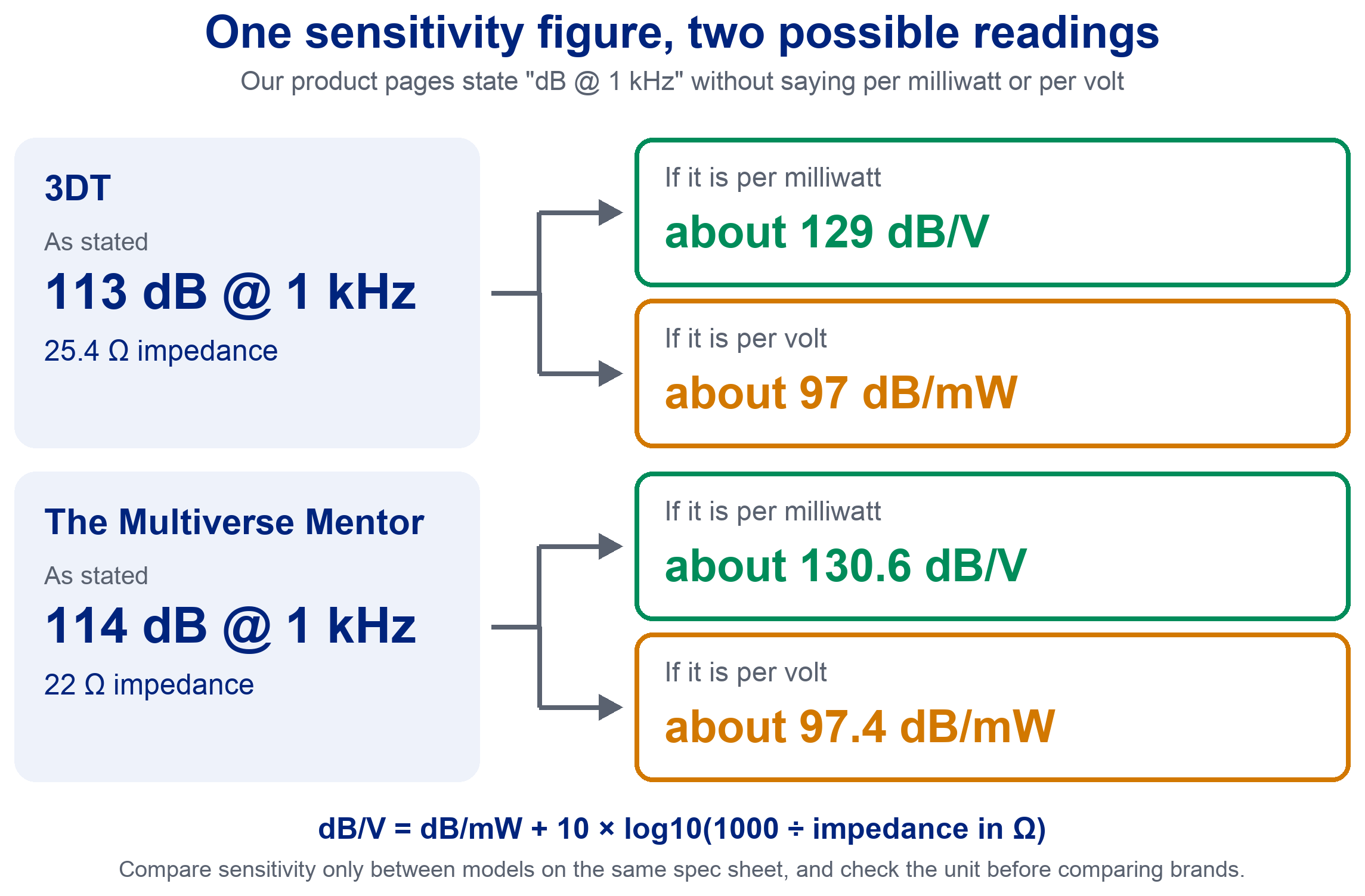
Our product pages give sensitivity as, for example, “113 dB @ 1 kHz”, without saying whether that is per milliwatt or per volt, and the MEST Fortune page gives 107 dB with no frequency at all. We would rather say so plainly than guess the unit.
Because power equals voltage squared divided by impedance, one unit converts to the other: dB/V = dB/mW + 10 × log10(1000 ÷ impedance in Ω). At our stated impedances that difference is 16 to 20 dB, and 20 dB is ten times the voltage.
So the 3DT’s 113 dB works out at about 129 dB/V if it is a per-milliwatt figure, or about 97 dB/mW if it is per volt. The Multiverse Mentor’s 114 dB at 22 Ω becomes about 130.6 dB/V, or about 97.4 dB/mW. Our rule is to compare sensitivity only between models on the same spec sheet, and to check the unit before comparing brands.
What do the Unique Melody figures say?
Across our range, ten models state an impedance between 10 Ω and 25.4 Ω, and seven state a sensitivity between 106 dB and 114 dB. The 2HT and Maven III Moonshard state neither figure, and the Stardust, MEST MKIII CF Blue and Mason FS state impedance only.
| Model | Impedance (as stated) | Sensitivity (as stated) | 1/8 rule: source output impedance below | Plug options |
|---|---|---|---|---|
| From The Start | 23.8 Ω | 106 dB @ 1 kHz | 2.98 Ω | 4.4 mm balanced |
| 2HT | not stated | not stated | n/a | 3.5 mm |
| 3DT | 25.4 Ω | 113 dB @ 1 kHz | 3.18 Ω | 3.5 mm |
| Stardust | 11.7 Ω | not stated | 1.46 Ω | 3.5 mm, 4.4 mm or 2.5 mm balanced |
| MEXT | 16 Ω | 108 dB @ 1 kHz | 2.00 Ω | 3.5 mm, 4.4 mm or 2.5 mm balanced |
| MEST MKII | 12.3 Ω | 112 dB @ 1 kHz | 1.54 Ω | 3.5 mm, 4.4 mm or 2.5 mm balanced |
| MEST MKIII CF Blue | 14 Ω | not stated | 1.75 Ω | 3.5 mm, 4.4 mm or 2.5 mm balanced |
| MEST Jet Black | 12.6 Ω | 106 dB @ 1 kHz | 1.58 Ω | 3.5 mm, 4.4 mm or 2.5 mm balanced |
| Maven III Moonshard | not stated | not stated | n/a | 4.4 mm balanced |
| MEST Fortune | 10 Ω | 107 dB (frequency not stated) | 1.25 Ω | 4.4 mm balanced |
| The Multiverse Mentor | 22 Ω | 114 dB @ 1 kHz | 2.75 Ω | 4.4 mm balanced |
| Mason FS | 23 Ω | not stated | 2.88 Ω | 4.4 mm balanced |
The fourth column is each stated impedance divided by eight, the rule of thumb explained below; read it as a guide, not a pass mark. The seven stated sensitivities sit within 8 dB of each other, so on paper none is a demanding load.
Why is an IEM’s impedance not one number?
A multi-driver IEM’s impedance changes with frequency, because a passive crossover splits the signal between drivers and every driver has its own resonance. The single ohms figure on a spec sheet is a reference point, not a constant.
Putniņš puts it directly: “IEM impedance curves can have many dips and peaks as all of the drivers have their own resonances, and passive filters always alter the electrical impedance of a system as well.” He reports that Sonarworks measured 797 headphone models and found “57 percent have some variance of impedance with frequency.”
His example is the Shure SE535, rated at 32 Ω nominal but dipping to 9 Ω. Most of our models use crossovers too, from the 4-way Stardust to the 6-way MEST Fortune, so we read their single figure the same way.
What is output impedance, and why does the 1/8 rule matter for IEMs?
Output impedance is the source’s own internal resistance, and because it sits in series with the IEM, the pair forms a voltage divider. When the IEM’s impedance dips and peaks, the divider changes the level frequency by frequency, and the source alters the tuning.
Putniņš describes the result as “a form of equalisation on top of your headphone’s native frequency response.” With the SE535 driven from sources between 1 and 50 Ω, his chart shows a maximum deviation of 7.5 dB.
The usual safeguard is a ratio. Shure’s guide says you want a source with “an output impedance that is lower (often by a factor of 8)”, and the engineer known as NwAvGuy spells it out: “just divide the headphone impedance by 8 to get the maximum output impedance without potential audible degradation.”
Applied to our range, the MEST Fortune at 10 Ω wants a source below 1.25 Ω, while the 3DT at 25.4 Ω has room up to 3.18 Ω. Page 2 of the Sound On Sound impedance feature reports Sonarworks measurements of 170 devices, where “most fall in the 1 to 10 Ω range”, and notes that “Apple and Samsung smart devices had very little trouble providing low output impedance.” A phone near 1 Ω is inside the rule for every model in the table; one near 10 Ω is outside it for all of them.
Why do sensitive, low-impedance IEMs hiss on some sources?
Hiss is the source’s own noise floor made audible. Every DAC and amplifier puts out a little noise with no music playing, and a highly sensitive IEM turns that tiny voltage into sound you can hear.
The audio maker RME explains it on its ADI-2 DAC page: “Modern IEMs are extremely sensitive and operate on very low voltages. As a side effect they uncover the noise floor of the player, DAC or headphone amp.” RME’s answer was a dedicated IEM output with a noise floor it states is 10 dB lower than its Extreme Power headphone output, and an output impedance “near zero Ohms”.
Hiss and tonal shift are separate problems. Replying to a reader, NwAvGuy wrote that “output impedance isn’t directly related to hiss and noise.” In our view, sensitivity matters more than impedance here, and an IEM at 16 Ω or above can still hiss if it is sensitive enough.
Pausing the music is a fair test, since anything left is the source’s noise floor. On gain, Putniņš notes that “Keeping an amp at low gain comes with numerous performance advantages: a stronger negative-feedback loop controls the amp more precisely, for lower noise and lower distortion.”
Will your phone drive them, and when does an amp add nothing?
For volume, a phone or a basic dongle is usually enough, because IEMs between 10 Ω and 25.4 Ω need only a fraction of a volt. Power equals voltage squared divided by impedance, so 1 mW into 16 Ω takes about 0.126 V, and into 25.4 Ω about 0.159 V.
Turn it round and 1 V into 10 Ω is 100 mW, far more than the 1 mW reference; each extra 6 dB needs twice the voltage. The 3DT product page sums it up: “It is very easy to drive, so a phone with a simple USB-C dongle is enough.”
An external amp adds nothing if your source already reaches your usual level with volume to spare, stays under the 1/8 figure for your model and is silent when you pause the track. If it falls short on one of those, the question becomes which source to use, and do you need a DAC for IEMs walks through phones, dongles and players.
The five 4.4 mm-only models need a 4.4 mm socket or an adapter, and a balanced output can differ from the same player’s single-ended one in volume, noise floor or output impedance; 3.5 mm vs 4.4 mm balanced plugs explains the wiring.
So how should you read an IEM spec sheet?
Read impedance and sensitivity together, check the unit behind the dB, and set the ohms figure against your source’s output impedance rather than against other IEMs. On our range, the numbers say a phone or a basic dongle covers volume. What a source changes is tonal balance and hiss.
Where a product page gives no figure, we write “not stated” rather than guess. To compare models, plug options and UK terms side by side, see our page for Unique Melody in-ear monitors (UK). Then plug in, pause the music and listen to the silence.