
 Sleeping
 Concerts
 Motorcycle
 Swimming
 Work
Work Kids
Kids

⏱️ Estimated reading time: 12 min

Key Takeaways
OSHA standards are legally enforceable rules that define how workplace hazards must be controlled to protect workers’ health and safety. They set minimum requirements for exposure limits, safety procedures, training, and protective equipment across different industries.
It is 29 CFR 1910.95, the occupational noise exposure standard for general industry. It sets an 85 dBA action level and a 90 dBA permissible exposure limit, both as 8-hour time-weighted averages.
Employers must offer hearing protectors free of charge at 85 dBA. Wearing them becomes mandatory above 90 dBA, or from 85 dBA for a worker whose hearing tests show a standard threshold shift.
Subtract 7 dB from the NRR when noise is measured in dBA, then halve the result where OSHA applies its 50% safety factor. An NRR of 29 becomes an estimated 11 dB of real protection.
No. Canada, Australia, New Zealand, Ireland and the UK each set their own noise limits, and most of them use an 85 dB(A) daily level and a 3 dB exchange rate rather than OSHA’s 90 dBA and 5 dB.
No, earplugs are not meant to be a standalone solution. OSHA standards require employers to first assess and control noise at its source where possible, and earplugs sit inside a wider programme of monitoring, hearing tests and training.
OSHA standards are legally enforceable rules issued by the US Occupational Safety and Health Administration that tell employers how workplace hazards must be controlled. For noise, the OSHA hearing protection standard is 29 CFR 1910.95: an 85 dBA action level, a 90 dBA permissible exposure limit and a full hearing conservation programme once workers cross that first line.
At Bollsen, we make reusable silicone hearing protection, German-tested, independently certified 24 dB, and we write for readers in the UK, the US, Ireland, Australia and Canada. That mix is why this guide covers more than OSHA. If you buy work earplugs for a team spread across countries, the decibel limits, rating labels and derating maths change at every border. Our explainer on what are earplugs and how they are rated is the starting point for all of it.
What Are OSHA Standards and How Do They Protect Workers?
OSHA standards are legally binding requirements issued and enforced by the Occupational Safety and Health Administration in the United States, published in Title 29 of the Code of Federal Regulations. Their purpose is to protect workers from recognised hazards that can cause injury, illness or death, and they apply to most private-sector workplaces.
Each standard describes what employers must do: exposure limits, safety procedures, training and protective equipment. OSHA standards are not suggestions or best practice. When employers fail to comply, OSHA can inspect, issue citations and impose penalties.
General industry falls under Part 1910 and construction under Part 1926. For noise, that means 29 CFR 1910.95 for factories, warehouses and most fixed sites, and 29 CFR 1926.52 for building sites, which uses the same 90 dBA limit.
How Does OSHA Control Workplace Hazards and Noise Exposure?
OSHA controls noise through the hierarchy of controls: remove or quieten the source first, then change how work is organised, and use hearing protection as the last layer. Under 29 CFR 1910.95, feasible engineering or administrative controls must be used whenever exposure exceeds the 90 dBA permissible exposure limit.
The limit uses a 5 dB exchange rate, so the allowed time halves with every 5 dB increase. The regulation’s Table G-16 allows 8 hours at 90 dBA, 4 hours at 95 dBA and 2 hours at 100 dBA. Impulse or impact noise should not exceed 140 dB peak sound pressure level.
Plenty of everyday kit crosses the 85 dBA action level, from angle grinders and circular saws to leaf blowers. Our chart of how loud are power tools lists typical dB(A) readings by tool, so you can see which jobs push a shift past 85 dBA before anyone measures it.
NIOSH, the US research agency, recommends a stricter 85 dBA limit with a 3 dB exchange rate. That recommendation is not law, but it is the rule most other countries follow, which matters when we compare them below.
What Does the OSHA Hearing Protection Standard Require?
Once any worker’s 8-hour exposure reaches 85 dBA, or a 50% noise dose, the OSHA hearing protection standard (29 CFR 1910.95) requires a hearing conservation programme. It has five parts.
- Noise monitoring to identify who is at or above 85 dBA, with records kept for 2 years.
- Audiometric testing: a baseline audiogram within 6 months of first exposure, then a new one at least every year, with records kept for the length of employment.
- Hearing protectors made available at no cost, with workers free to choose from a variety of suitable types.
- Training on noise, protectors and testing, repeated every year.
- Recordkeeping that workers and their representatives can access.
Wearing protection is mandatory above the 90 dBA limit, and from 85 dBA for anyone whose audiogram shows a standard threshold shift. Can an employer make you wear them? Under OSHA, yes, above the PEL. Our UK guide to can my employer make me wear earplugs covers the rules on the other side of the Atlantic.
The protector itself must bring exposure down to 90 dBA or below, or to 85 dBA or below after a threshold shift. The yearly audiogram is the routine check that the programme is working, much like the UK approach to workplace hearing tests.
How Are Earplugs Used as an OSHA-Recognized Safety Tool?
Earplugs count as personal protective equipment under OSHA, and in the US every protector carries a Noise Reduction Rating (NRR) in decibels on its packaging. The NRR comes from laboratory fitting, so OSHA does not let employers subtract it straight from a dBA reading.
The OSHA Technical Manual sets the method. Subtract 7 dB from the NRR to convert a C-weighted rating for A-weighted measurements, and when judging whether engineering controls are needed, apply a further 50% safety factor: estimated exposure = TWA − [(NRR − 7) × 50%]. Workers shorten it to “subtract 7 and divide by 2”, and it is the reason a box reading NRR 33 does not make a 115 dBA job safe.
NIOSH goes further and derates by protector type: 25% off for earmuffs, 50% for formable foam plugs and 70% for other earplugs. For the UK method of matching a protector to a noise level step by step, see our guide how much hearing protection do I need.
Wearing plugs under earmuffs does not add the two ratings together. OSHA’s manual takes the better protector’s adjusted figure and adds just 5 dB, which is why double hearing protection is reserved for the loudest work rather than used by default.
How Do NRR and SNR Ratings Compare?
The SNR (Single Number Rating) is the rating used in the UK, Ireland and the EU, and earplugs are tested for it under EN 352-2. SNR and NRR come from different test methods, so the same protector usually shows an NRR a few decibels lower than its SNR, and one figure cannot be converted precisely into the other.
For the full background, our NRR vs SNR explained guide compares how both ratings are measured and why the label numbers differ.
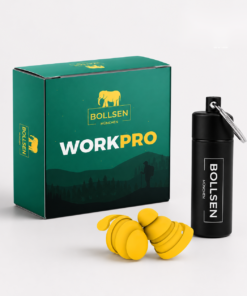
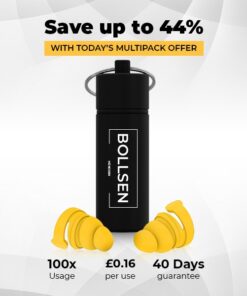
Our WorkPRO earplugs (SNR 24 dB, £29.95) are rated SNR 24 dB (H 24 / M 21 / L 19) under EN 352-2 by PZT GmbH. WorkPRO is SNR-tested only, so we do not quote an NRR for it, and you should not convert one yourself. It is a passive silicone earplug, reusable up to 100 times, and like any passive plug it reduces high frequencies more than low ones.
How Do OSHA Rules Compare With Canada, Australia, New Zealand, Ireland and the UK?
The US is the outlier. The other English-speaking markets we serve work from 85 dB(A) (87 dBA for federally regulated Canadian workplaces) with a 3 dB exchange rate, so at 85 dB(A) a single hour at 94 dB(A) uses the whole daily allowance, against less than a quarter of it under OSHA.
| Jurisdiction | Action level | Exposure limit | Rating system | Derating convention |
|---|---|---|---|---|
| US (OSHA, 29 CFR 1910.95) | 85 dBA 8-h TWA | 90 dBA PEL, 5 dB exchange; 140 dB peak | NRR | (NRR − 7) × 50% (OSHA Technical Manual) |
| Canada (federal / provinces) | 85 dBA in all 13 provinces and territories | 87 dBA federal, 3 dB exchange | NRR | Set by each jurisdiction |
| Australia / New Zealand | Exposure standard applies directly | 85 dB(A) LAeq,8h; 140 dB(C) peak | SLC80, AS/NZS 1270 Class 1–5 | Class matched to noise level (AS/NZS 1269) |
| Ireland (S.I. No. 299 of 2007) | 80 dB(A) lower, 85 dB(A) upper | 87 dB(A); peaks 135 / 137 / 140 dB(C) | SNR (EN 352) | Limit value counts protector attenuation |
| UK (Control of Noise at Work Regulations 2005) | 80 dB(A) lower, 85 dB(A) upper | 87 dB(A); peaks 135 / 137 / 140 dB(C) | SNR (EN 352) | HSE: subtract 4 dB for real-world use |
What Are the Noise Rules in Canada, Australia and New Zealand?
In Canada, the limit depends on who regulates the workplace. According to CCOHS noise exposure limits in Canada, federally regulated employers work to 87 dBA over 8 hours under the Canada Occupational Health and Safety Regulations, while all 13 provinces and territories use 85 dBA, almost all with a 3 dB exchange rate.
In Australia, the WHS Regulations set an exposure standard of 85 dB(A) LAeq,8h or a peak of 140 dB(C), explained in the Code of Practice on managing noise and preventing hearing loss at work. Protectors are rated by SLC80 and grouped into AS/NZS 1270 classes: Class 1 (SLC80 10–13) for exposure below 90 dB(A), up to Class 5 (SLC80 26 or more) for 105 to 110 dB(A). Workers who frequently have to wear protectors must also be offered audiometric testing.
New Zealand uses the same 85 dB(A) 8-hour level and 140 dB peak, and WorkSafe New Zealand stresses that the limit applies whether or not workers wear hearing protection.
Do OSHA Standards Apply in Ireland and the UK?
No. Ireland follows Chapter 1 of Part 5 of the Safety, Health and Welfare at Work (General Application) Regulations 2007, which set a lower action value of 80 dB(A), an upper action value of 85 dB(A) and a limit of 87 dB(A). Only the 87 dB(A) limit takes the protector’s attenuation into account.
The UK uses the same three values under the Control of Noise at Work Regulations 2005, with peaks of 135, 137 and 140 dB(C). Our guide to the Control of Noise at Work Regulations 2005 explains each employer duty, from risk assessment to hearing protection zones.
For selection, HSE advises derating hearing protectors by 4 dB for real-world factors such as fit and glasses. It also asks for a level below 85 dB at the ear, while avoiding protectors that take you below 70 dB, because over-protection makes communication and warning signals harder to pick up.
So Which Hearing Protection Standard Applies to You?
The rule that applies is the one where you work. US sites follow OSHA’s 85 and 90 dBA lines and derate NRR labels, while Canada, Australia, New Zealand, Ireland and the UK work from 85 dB(A) or lower with a 3 dB exchange rate.
Whichever system you work under, the protector only counts if it fits and stays in all shift. Our guide to the best earplugs for work compares reusable, foam and banded options by noise level and comfort. Hearing lost to noise does not come back, which is why the routine of wearing protection matters more than any single number on the box.